
Built to yourspecification,not to a catalogue
Denier, cut length, crimp and finish are set by the order rather than by a standing range - then verified in-house, sealed at 200–300 kg and documented for export before it leaves the floor.
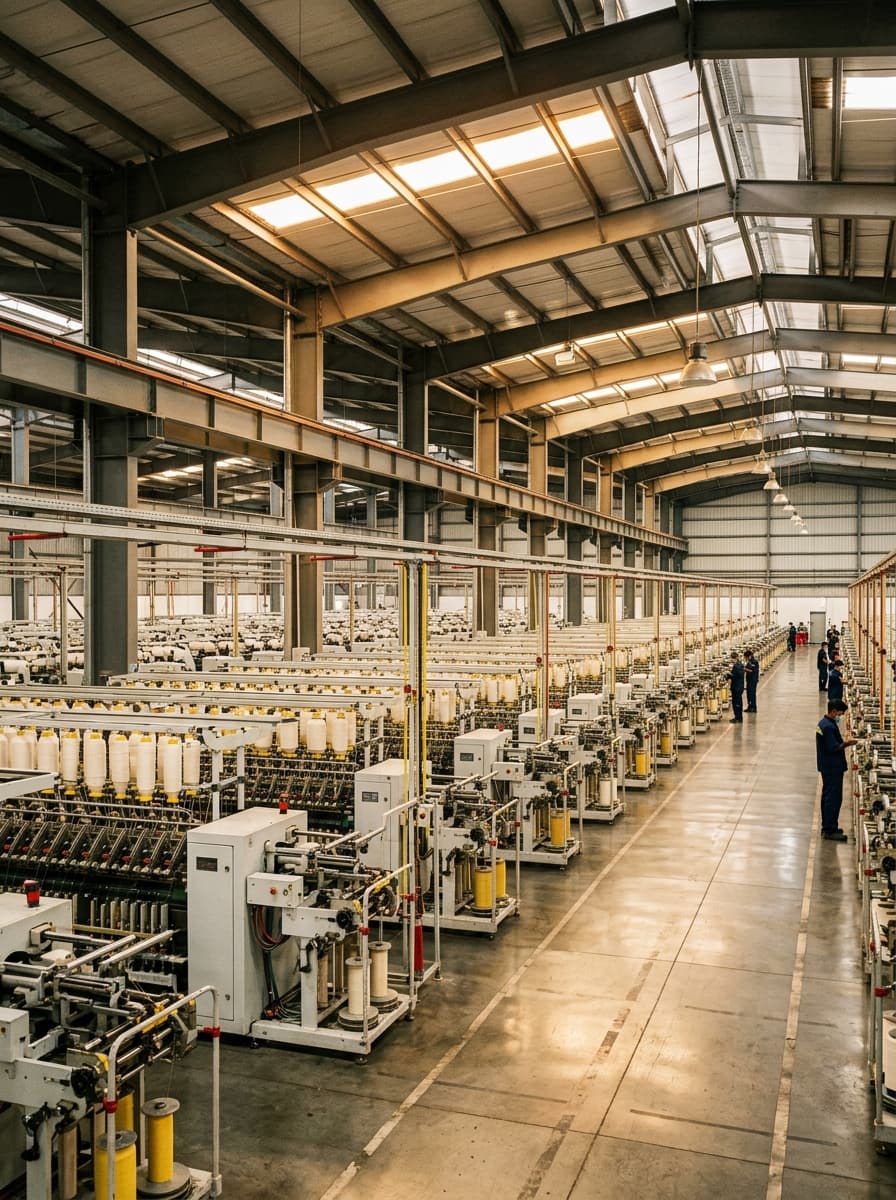
Four things we do
for every order
Specification, verification, packing and export documentation are handled by the same operation, which is what keeps an agreed figure intact from melt to intake.
Custom Specifications
Tailored denier, cut length, crimp frequency, and finish chemistry.
Quality & Testing
In-house testing, tensile analysis, moisture verification, and COA documentation.
Packaging & Handling
Moisture-sealed baling (200–300 kg standard) and protective roll wrapping.
Export & Logistics
Full export documentation, container loading, and dedicated shipping coordination.
What happens
when you work with us
Seven steps from your requirement to a delivered, documented consignment - each one a capability the house actually holds, walked here as a single scroll.
- Step 01 - of 07
Your requirement
The enquiry arrives as a specification - denier, cut length, crimp frequency, finish chemistry, volume and destination - rather than as a catalogue number.
- Step 02 - of 07
Specification agreement
Custom specification is the first capability of the house: the order is read against the 1.2D-60D range and agreed figure by figure before anything is made.
- Step 03 - of 07
Manufacturing
Production runs the published four-stage sequence - flake refining, melt extrusion, drafting and crimping, cutting and baling - on the company’s own line.
- Step 04 - of 07
Verification
In-house testing at the points that decide the bale: incoming feedstock control, tensile analysis, moisture verification, and a Certificate of Analysis per consignment.
- Step 05 - of 07
Packing
Moisture-sealed baling at 200–300 kg standard, or protective roll wrapping for wadding, felt and interlining goods.
- Step 06 - of 07
Documentation & loading
Full export documentation is prepared in-house and container loading is coordinated by Gulf Fibre, so one party is accountable for what ships.
- Step 07 - of 07
Delivery
The consignment arrives with its COA, so the receiving mill can reconcile delivered material against the agreed specification.
From flake
to sealed bale
The four stages published on the homepage, read here as the route an order actually travels.
Polymer Sorting & Flake Refining
Incoming post-consumer PET and clean polymer are sorted, washed and refined to a consistent flake feedstock before any melt stage begins.
Melt Extrusion & Quenching
Refined feedstock is melted and extruded through spinnerets, then quenched to lock filament geometry and set the target linear density.
Drafting & Thermomechanical Crimping
Filaments are drawn to develop molecular orientation and tenacity, then thermomechanically crimped to the bulk and cohesion the end process requires.
Rotary Cutting & Moisture-Baling
Tow is cut to the specified staple length and pressed into moisture-sealed bales for damage-free transit and automated warehouse handling.
Source: Homepage ProcessSection
What we need
to quote properly
- Denier
- Target count within 1.2D - 60D
- Cut length
- Set per order rather than from a standing range
- Crimp & finish
- Crimp frequency and finish chemistry to your process
- Feedstock
- Recycled (100% post-consumer PET) or prime polymer
- Volume & destination
- Quantity and delivery country, for packing and documentation
Lead time and minimum order quantity
Neither is recorded in this repository. Confirm the standard lead time per line and the MOQ, and they will be published here where buyers look for them first.
Incoterms and loading ports
Export documentation and container loading are handled in-house, but the specific Incoterms offered and ports used are not verified here.
How the order
leaves the floor
Packing, documentation and loading are coordinated in-house rather than subcontracted, so one party is accountable for what arrives.
- Standard baling
- 200–300 kg, moisture-sealed with high-tensile strapping
- Roll goods packaging
- Heavy-duty protective poly-wrapping (wadding, felt & interlinings)
- Export logistics
- FCL container loading coordinated from Lahore plant to Karachi ports
- Consignment documentation
- In-house export documentation & consignment Certificate of Analysis (COA)
Send the order sheet.
We will answer on feasibility.
Denier, cut length, volume and destination are enough for a firm answer on whether we are the right plant for the job.